“Duco Burgers strikes exactly the right tone in every case.”
– Magazin Klassik
“A highly developed art of phrasing and articulation ensures that the music always is lively and spontaneous.”
– Pizzicato Magazine
“I highly appreciate Duco Burgers’ deeply powerful reading of my teacher’s music, his solid pianism sculpting her thematic materials with eloquent gravitas.”
– Émile Naoumoff
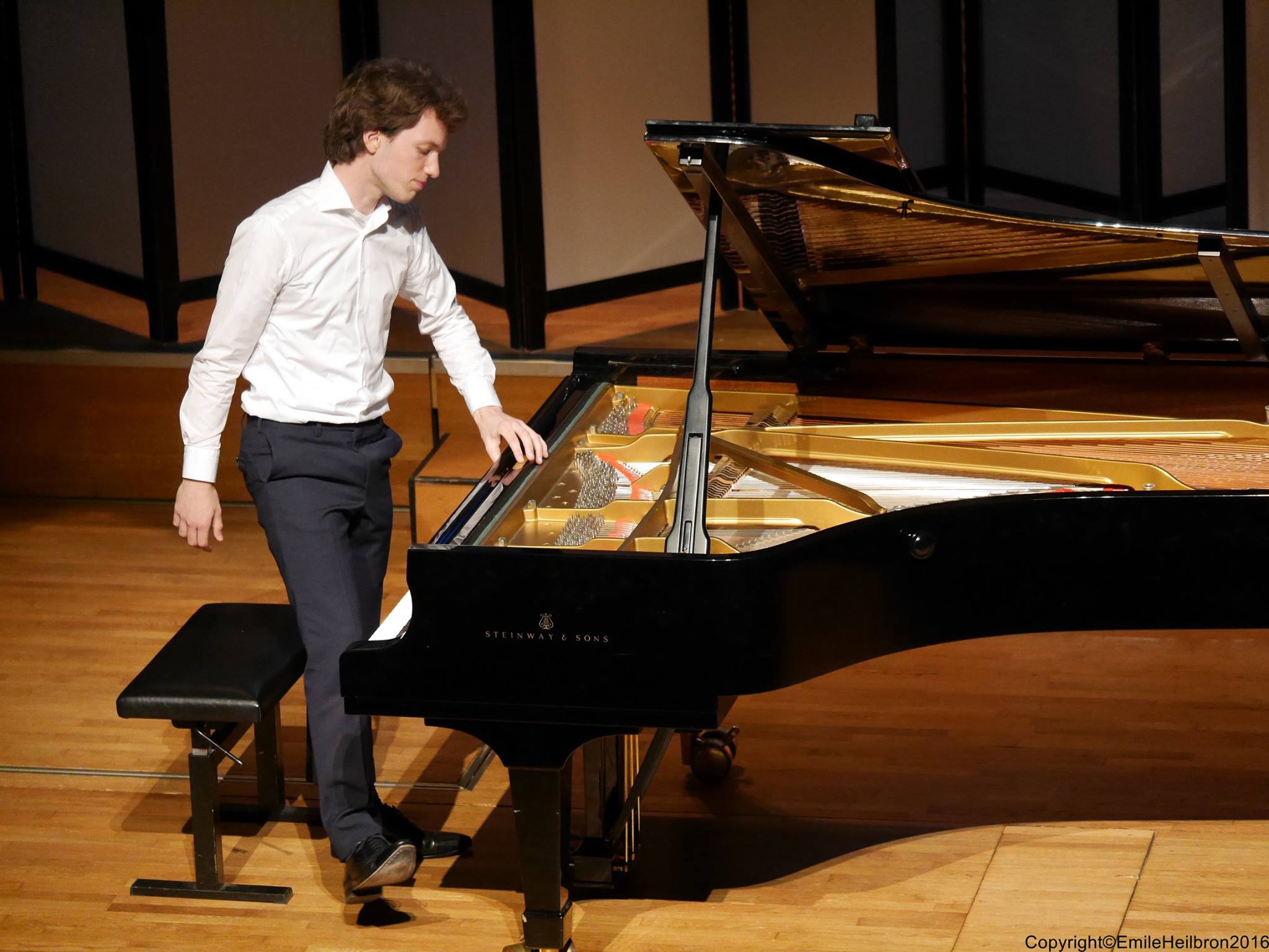
Duco Burgers is a pianist whose musical voice is shaped as much by literature and language as by the piano itself.
He performs regularly in the Netherlands and abroad, with appearances in France, Switzerland, Greece, and Hungary.
His debut recording — a complete album devoted to the piano works of Lili and Nadia Boulanger — received enthusiastic reviews from international critics and from Boulanger specialist Émile Naoumoff.
He has also recorded works by Paul Seelig, Simon Burgers, and Darius Milhaud, with releases available on YouTube and Spotify.
He first came to attention at the age of ten, when he won the Dutch Wind Ensemble’s annual composition competition with his piece De Kloof, performed at their New Year’s concert in the Concertgebouw.
Alongside his musical training, Duco cultivated a broad cultural background, studying German literature at the University of Amsterdam and literary translation at Utrecht University.
His studies in language and literature continue to shape his musical thinking.
Duco studied piano with Henk Mak van Dijk, Peter Beijersbergen van Henegouwen, Bernd Brackman, and, from 2012 to 2018, with Klára Würtz at the Utrecht Conservatory, where he graduated with the highest distinction.
He has participated in masterclasses with renowned pianists including Igor Roma, Enrico Pace, Rian de Waal, and Fumiko Eguchi.
In addition to his work as a performer, Duco is active as a repetiteur and teaches music theory at the Utrecht Conservatory.
He also lectures on European literary history at the Vrije Universiteit Amsterdam (HOVO).
Lili Boulanger (1893-1918), Complete works for piano solo.
I have also included some commentary on this fascinating, introverted music.
Simon Burgers (1958-), Piano trio. With Carien de Bakker (violin) and Camillo Cabassi (cello).
Darius Milhaud (1892-1974), Suite pour le piano (1913)
Paul Seelig (1876-1945), Piano Concerto in F sharp minor. With Maarten Boogaard as soloist, Duco Burgers playing orchestra.
Simon Burgers (1958-), Chrysoliet.
Johanns Brahms (1833-1897), Cello sonata no. 2 in F major Op. 99, 1. Allegro vivace. With Camillo Cabassi (cello).
Ensembles and Concertprogrammes
Lili Boulanger (1893–1918)
Prélude en ré (1911)
Trois Morceaux pour piano (1914):
• D’un vieux jardin
• D’un jardin clair
• Cortège
Thème et Variations (1915)
Prélude en si
Nadia Boulanger (1887–1979)
Morceau de concours, hommes (1914)
Morceau de concours, femmes (1914)
Trois Petites pièces pour piano (1914)
Vers la vie nouvelle
Maurice Ravel (1875–1937)
Le Tombeau de Couperin
Piano and violin duo: Jorinde Gray and Duco Burgers.
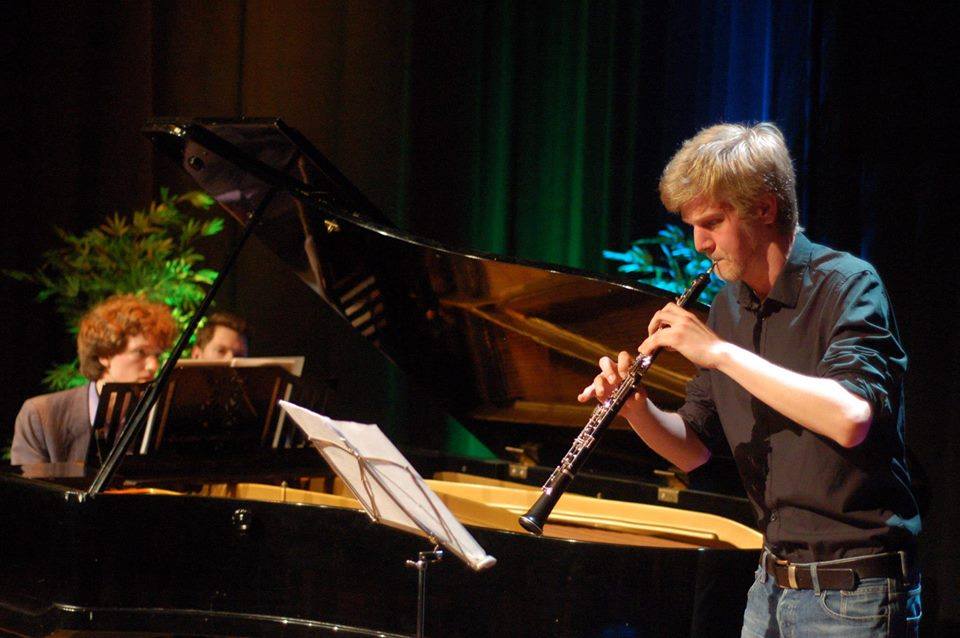
Gerard Dou Duo: Quentin Rychner (oboe) and Duco Burgers. Program:
Music is an undisputable enrichment of life
Why piano?
Pianolessons are the key to the universe of music.
The piano is both a melodic and a percussive instrument, allowing you to play beautiful melodies as well as swinging rhythms—on the piano one can transform almost all music genres into sound. Moreover, the piano is a polyphonic instrument. Whereas with singing, violin, or clarinet one usually has to play with accompaniment, on the piano you can do everything yourself. Versions of almost all the famous compositions exist for piano! The piano is also the instrument that makes music theory easy to understand. By playing the piano, one easily learns the intervals, scales, and harmony that form the foundation of all music.
What do we do in the lesson?
During the lessons the emphasis is always on the music itself: the piano is only the means with which we go on a voyage of musical discovery. That’s worth the effort, for music indisputably enriches your life. The goal of the lessons is, on the one hand, to understand music as a language in order to express certain emotions; on the other hand, it is important to develop a good technique in order to fully do justice to the music. During lessons there is, finally, always some attention to the (cultural) context of the music.
Feel free to contact me to make an appointment for a free trial lesson!
I am a member of The Amsterdam Music Teacher Collective (MDCA Muziek Docenten Collectief Amsterdam). To learn about other possibilities, check out their website.